
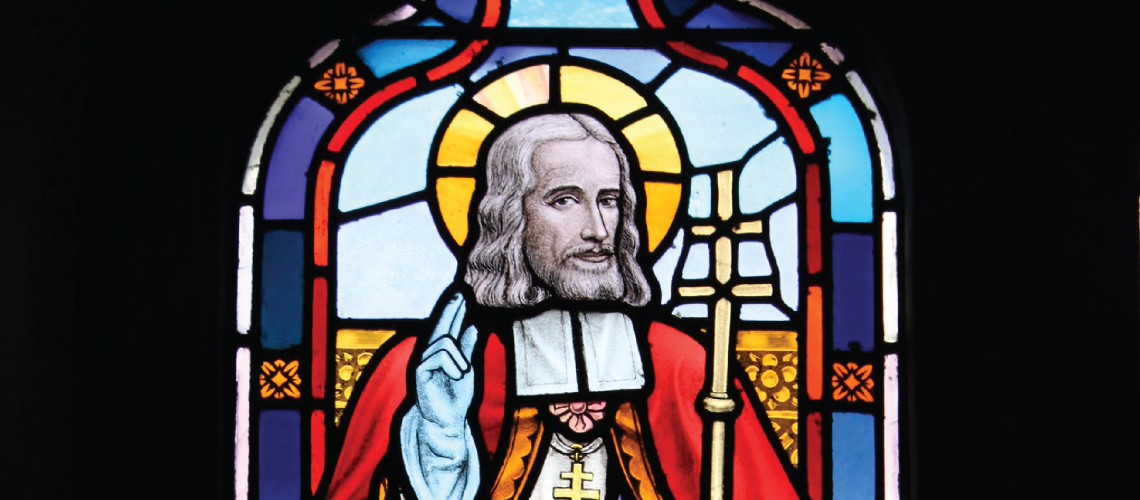
St. Peter’s, Drogheda | Sunday July 7, 2002 | E. Griffin, O.Carm.
There is an illustration in The Book of Kells, which as you know is preserved in Trinity College, Dublin, which is strangely appropriate to the story of the Saint whose memory we observe today, Oliver Plunkett. Such illustrations moved Gerard of Wales to ecstasy when he visited Ireland in 1185. He described these illustrations he discovered as the work of angels rather than the work of men… The quality of the lettering, the wild imagination with which wild beasts and human figures are interwoven with the Latin texts and with abstract patterns leave us in awe. How could the medieval monks have produced such works of utter beauty along with such delicate harmony? What lies behind such extraordinary artistry is a profound penetration of the Scriptures. An extraordinary grasp of biblical images along with the liturgical life of the monastery which brings the Bible and the images alive in celebration. The Welsh cleric could only explain such beauty in terms of an angelic visitation to the artist.
The illumination I have in mind is the arrest of Christ which will throw light not only on the arrest of Oliver Plunkett, on the treachery that brought his arrest about and on Oliver’s reaction to such treachery, which was a Christ like act of total surrender to his imprisonment and martyrdom. The arrest of Christ as illustrated in the Book of Kells is shown against another story – the story of the Last Supper and the institution of the Eucharist. In modern terms it’s almost like a multi-media presentation. The figure of Christ shown against the background of the Last Supper stands in a rather formal pose facing the viewers while two smaller figures seize his arms. There is no sign of struggle. The faces and the bodies are calm and composed as his body is delivered unto death. But if this was meant to be simply an illustration of the arrest of Christ then we would expect it to be accompanied by the story in the Gospel which tells of the arrest. Instead it accompanies another story, surprisingly the narrative of the Last Supper and the Institution of the Eucharist. By this simple device of moving the illustration from one context to another the arrest ties together two distinct stories, the arrest and the Last Supper. What is the significance of such a move? At his arrest Christ was ‘handed over’ to the soldiers by Judas. But at his Last Supper Jesus subverted this act of treachery and betrayal by handing himself over to his disciples — saying ‘take and eat this all of you for this is my body which is broken for the life of the world.’
These two images of the arrest of Christ and the Last Supper story form a perfect backdrop to the Oliver Plunkett story – treachery, betrayal, arrest, and death on the gallows, matched by laying down his life for his flock. ‘We shall not abandon the sheep or the lambs until they drag us to the boat with ropes around our necks.’ ‘Greater love than this no man or woman hath….’
Treachery and betrayal
From the day he set foot in Ireland after an absence of 23 very happy years in Rome, Oliver Plunkett was hounded by different factions. Many of the clergy and laity in this Diocese of Armagh resented a Meath man coming in as their Bishop, especially a man from the landed gentry who was very much associated with the British. ‘The labourers are few,’ he claimed, ‘they had little knowledge of the art of arts, that is the guidance of souls.’ The priests were cast adrift living with laity trying to eke out a living. Drunkenness was not unknown among them. Indeed many of them frequented local taverns for solace and company. The presence of a strong and reform-minded bishop was very unwelcome. He tried to provide for their lack of education and for the education of a well-informed laity by introducing the Jesuits to this town of Drogheda in 1670. The real treachery came from the friars. They had stuck to their posts during the time of Cromwell. They showed great heroism and were very much revered. But hard times took their toll and they became lax especially in the smaller communities. Oliver complained about the friars questing especially in parish churches on Sunday. Sometimes Mass was held up for hours while friars and farmers haggled over pigs, geese and vegetables. The friars in turn complained about the meddlesome Archbishop and accused him of everything from simony to judicial murder. One friar, Anthony Daly, sought to have the Archbishop murdered promising absolution to the perpetrator.
Things came to a head in a dispute between the Franciscans and the Dominicans over the ownership of the friaries of Carlingford, Guala near Enniskillen, and Newtown in County Down. After protracted consultations the Archbishop decided in favour of the Dominicans. All hell was let loose. The news spread as far as Rome where two Franciscan students removed the head from a bust of Oliver in St Isidore’s College. They were sent packing but, nothing daunted, they applied for admission to the Order in Spain and in due course found themselves back in Ireland. They were the villains of the piece, John McMoyler and Hugh Duffy. They, along with Edmund Murphy, parish priest of Kileavy, who had been suspended from his parish by the Primate, along with a priest from Clogher and four others. All were part of the horrid Popish plot which was set in motion by the infamous Titus Oates. Oates told of a conspiracy to murder the King and of a massing of 20,000 soldiers to overtake the British Regent. Oliver was reported to be the prime mover of the plot. Some of the finest Catholic men in England were sent to the gallows with no one to speak on their behalf. One of the most disgraceful chapters in the annals of English justice. It seems an appalling act of treachery and betrayal on the part of his accusers at the trial, McMoyler, Duffy and their accomplices. Edmund Murphy, realising that he was giving evidence against his own Archbishop, began to hedge and was committed to prison for contempt of court. Oliver Plunkett was well prepared for his ordeal having endured his dark night in Newgate Prison where he was subjected to indescribable filth, uneatable food, with irons on his ankles supported by a heavy chain. ‘The fettering of his body was the freeing of his spirit,’ writes one of his biographers. He had reached a new and final stage in his life, a serenity, a transparency, a simplicity, a humility and a willingness to submit his own will to the will of others. Imagine the scene – at the end of a great hall sat the three judges in their gold chains and scarlet robes, headed by the Lord Chief Justice, Sir Frances Pemberton. The defence witnesses who were to have been present from Ireland only got as far as Holyhead. The jury gave its verdict in the space of fifteen minutes. Oliver Plunkett was pronounced guilty of high treason.
‘And therefore you must go from hence to the place from where you came, that is, to Newgate; and from thence you shall be drawn through the city of London to Tyburn; there you shall be hanged by the neck but cut down before you are dead, your bowls shall be taken out and burnt before your face, your head shall be cut off and your body divided into four quarters, to be disposed of as your majesty pleases. And I pray God to have mercy on your soul.’
So you can see how apt the illustrations is on the Book of Kells – the arrest of Christ – shown against the background of the Last Supper, being handed over to his death and Christ subverting this act of treachery and betrayal by giving his broken body in the Eucharist for the life of the world. Oliver Plunkett being handed over to his death by the accomplishes of the horrid Popish plot and subverting this treachery by his calm acceptance of his death on the gallows and by his willingness to forgive those who did concur, as he puts it, directly or indirectly to take away his life.
Oliver Plunkett was the last man to be martyred for the Catholic faith in England.
What has Oliver Plunkett to say to us today as we recall his trial which was a travesty of justice and his enduring a most cruel and vicious kind of martyrdom? He speaks to all.
The Celtic monks were wont to distinguish three kinds of martyrdom, the white martyrdom of chastity, the red martyrdom of the shedding of one’s own blood and the green martyrdom of daily struggle.
The White Martyrdom of Chastity
Chastity, in the monastic tradition, means far more than physical purity. Purity of body yes, but much more. Chastity includes purity of heart, nothing to defile the heart. The heart can be defiled so easily by materialism, a besetting vice in our time, by greed, by power, by attachment to somebody else partner or friend. All these can become idols. These lesser loves can be melted away by the deeper more powerful Love — which is the Love of God flowing into the Love of the neighbour.
The Red Martyrdom of the Shedding of Blood
There are more martyrs in our time than ever existed in the time of Oliver Plunkett or in the time of the Roman Empire. We think of those who died in the Concentration Camps of the last war. In more recent times we think of Oscar Romero, Archbishop of San Salvador who was shot on the evening of March 24, 1980 while offering mass in the small chapel of the Divine Providence hospital where he lived, having made his appeal to the ranks of the police and army forces to stop obeying immoral commands from officers to torture and kill fellow Salvadorians. Hilder Camera, Archbishop of Recife underwent a similar fate. Both men were assassinated for confronting the establishment in the name of the poor and dispossessed. On November 26, 1989, six Jesuits and two women were shot dead on the campus of a Central American University. Such assassinations are repeated across the world time and again, in the Congo Republic, Nigeria, other parts of Africa, Argentina where road accidents have been arranged, Christians are forbidden to exercise any kind of mission. We think of the killing fields of Vietnam and Cambodia — and the latest atrocity was the brutal massacre of 100 people by guerrillas in a village Parish Church in Columbia.
The Green Martyrdom of Daily Struggle
It was Romero himself who explained what it is to offer one’s life. To give one’s life is not just being killed by someone. To give one’s life is to have the spirit of martyrdom. To give through one’s duty, in silence, in prayer, in the faithful performance of one’s obligations. In that silence of daily life, to go on giving one’s life like the mother who, without fuss, with the simplicity of maternal martyrdom, gives birth, suckles her child, helps it grow and looks after it with love — this is to give one’s life.
We think of the 100’s of people from this town of Drogheda and beyond who travel 30 plus miles to their work everyday. Often both parents are at work, having to make provision for their children, coming home in the evening worn out and exhausted, sometimes not having the energy to get a meal ready. In the teeth of such demands some people find time for prayer for the religious formation of their children, for involvement even in the parish and even in the schools their children attend. Such people, like Oliver Plunkett, awaken, enlighten, and discomfit the rest of us. They are the Saints of today.